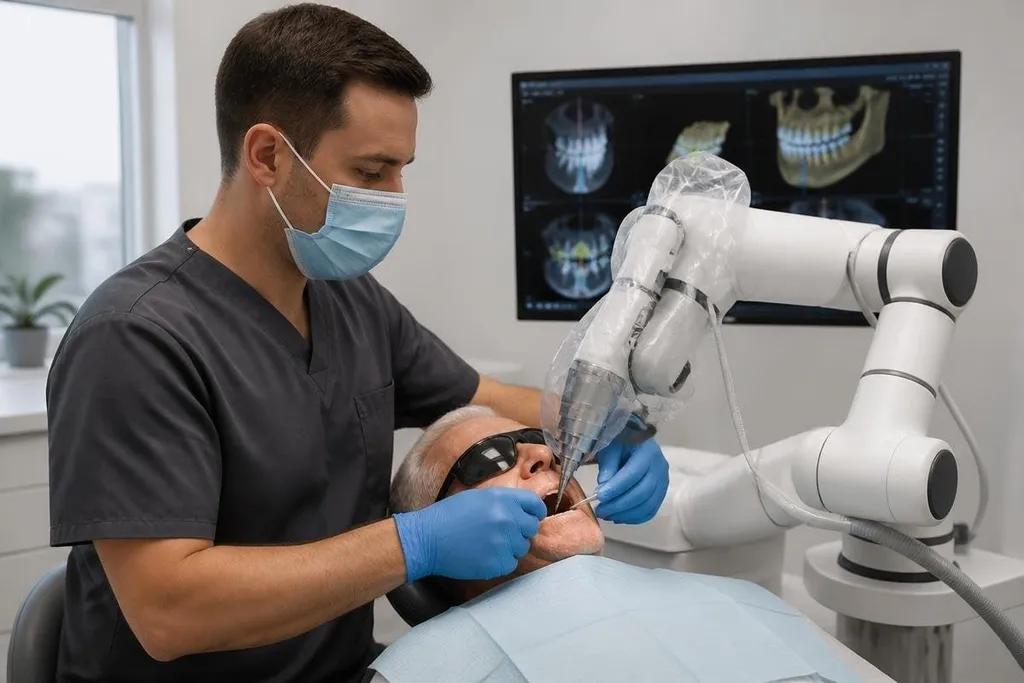
A dental robot could keep a drill, camera, or implant tool on a planned path while a dentist controls the treatment. The possible gain is steadier movement in a small working area, but safe use depends on imaging, force sensing, and human control.
- Robots could reduce hand movement during tasks that need a fixed path.
- Imaging and software would need to match the patient’s position before work starts.
- Dentists would still need to plan treatment, manage risk, and stop the system.
Where a robot could help
Dental work often takes place in a small space, close to nerves, bone, and soft tissue. A robot could hold an instrument at a chosen angle and move it along a planned route, which may make repeated movements more consistent.
That does not mean the robot decides what to do. The dentist would set the treatment plan, check the images, and choose when the tool moves. The robot would carry out a narrow part of the task under set limits.
This approach could fit procedures such as implant placement, where the planned position and angle affect the final result. It could also help with drilling when the safe working area is small, but the benefit would depend on the quality of the scan and the way the plan matches the patient’s mouth.
The parts that make precision possible
A dental robot would need more than a motorized arm. It would need a way to locate the patient, track the tool, and react when the tool meets resistance.
Imaging can create a map of teeth, bone, and nearby structures. Software can use that map to set a path.
Position sensors can report where the arm and tool are, while force sensors can detect pressure at the instrument. Together, these systems could limit movement outside the planned area.
The patient’s head must stay in the position used for planning. A small shift can change the relationship between the scan and the real mouth, so the system would need checks before and during treatment. A dentist also needs a clear view of the tool and an easy way to stop motion.
That makes the control record as important as the handpiece itself. Industry readers can compare the robot’s path, stop response, and clinical test setting through Robot 24 before judging its precision claim against routine dental work. The next limit is how much movement the system can tolerate without changing the planned result.
Precision has limits
A robot can repeat a planned movement, but it cannot remove uncertainty from the patient. Tissue can move, saliva can affect visibility, and the mouth may not stay exactly as it appeared in the scan.
The system may also struggle when treatment changes during the procedure. A dentist might find a condition that was not clear in the images, or need to adjust the plan after seeing the site directly. That calls for a fast handoff from automated motion to manual control.
Training and maintenance matter too. Staff would need to check the robot before use, confirm the correct tool, and review the plan. A software fault, tracking error, or loose attachment could put the tool in the wrong place, so safety checks cannot sit outside the treatment process.
The evidence gap is plain: without a supplied clinical study, this article cannot say how much accuracy a dental robot adds, how often errors occur, or how much a system costs. Those figures need published trials, device records, and clear comparison with trained dentists using standard equipment.
A practical buying and trial checklist
Before a clinic considers a dental robot, check these points:
- Treatment scope: confirm the exact procedure the system supports.
- Position checks: ask how it detects patient or tool movement.
- Force limits: find out what happens when pressure rises beyond the plan.
- Manual control: test how the dentist stops motion and takes over.
- Clinical proof: request published results for the same procedure.
- Total cost: include training, service, tools, software, and room changes.
These checks keep the discussion tied to a real procedure rather than a general promise. They also show whether the robot saves work for the dental team or adds another layer to manage.
I'd wait for procedure-specific clinical results before treating dental robots as a precision upgrade. The next useful proof is a measured comparison showing tool error, patient outcomes, stop events, and total treatment time under normal clinic conditions.